View more
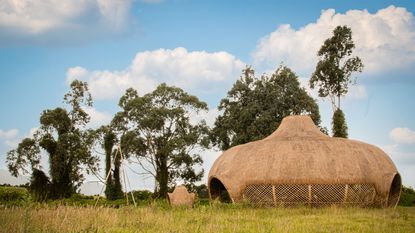
The term sustainability as it relates to design and architecture is so much a defining part of the zeitgeist that it is often interchangeable with other idioms like ‘green architecture’ or ‘passive design’. But ‘are we here to sustain something?' Colombian architect Ana María Gutiérrez asks herself constantly. She is the founder of Organizmo, an education and research centre for low-impact construction techniques, alternative technologies, and ecological restoration. 'And what exactly is regeneration? What is permaculture?' she continues. 'All these words that we grab and put into fashion are already alive and a huge part of the resilience in the communities [we work with].'
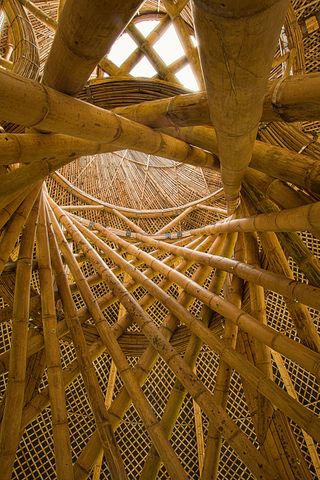
Inside the House of Thought, a toroidal structure at Fundacion Organizmo, built in collaboration with architect Jaime Pen
(Image credit: Courtesy of Organizmo)Gutiérrez, a trained architect, learned to work with the soil using different earthen techniques in Barichara, northern Colombia, and completed her training in bioconstruction in Brazil. After experiencing the practice of learning by doing in additional places like Amazonas, La Guajira, Orinoquía, and Chocó, she was invited to join local mingas, groups of people collaborating and building together. ‘By observing and living with them, I learned the rest,’ Gutiérrez says.
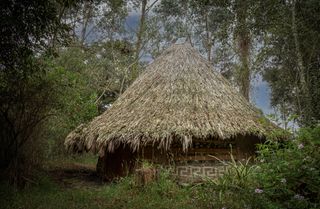
A building at Fundacion Organizmo that used local earth building techniques
(Image credit: Courtesy of Organizmo)Founded in the Tenjo municipality on the outskirts of Bogotá, an area known for agriculture and livestock farming, Organizmo is an experimental laboratory. It tests site-specific architectural solutions which are then built in collaboration with indigenous and Afro-descendant communities that have adapted to their unique environments over thousands of years. Colombia has distinct climate zones known as thermal floors, which vary from the Caribbean and Pacific coasts to the plateau region of the Andes and the Amazonian jungle.
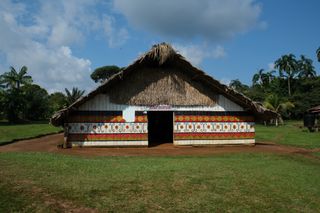
Maloca or House of Thought for Colectivo Takaka in Vaupe
(Image credit: Courtesy of Organizmo)Gutiérrez received the land in Tenjo 18 years ago as living inheritance from her father after it had been used as a dairy farm and for monoculture agriculture of corn, beans, potatoes and flowers. For the last ten years, the land has been in a process of regeneration, allowing the forest to grow back with the help of trained naturalists and working to re-introduce native pollinators, medicinal plants, and biodynamic agriculture.
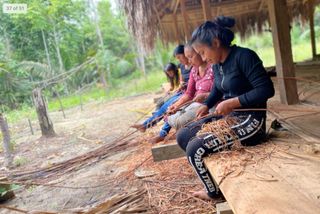
Indigenous Piaroa people peeling fibres for the construction of House Hotel, La Urbana Comunity, Selvas de Mataven (Image credit: Courtesy of Organizmo)
But the backbone of Organizmo has always been architecture. The first building on the property was a house made with PET bottles, followed by explorations on earth techniques and dry toilets. Other buildings were added, like yurts inspired by nomadic Mongolian tribes and EarthBag architecture houses, which consist of sandbags and barbed wire with a catenary curved roof, a technique developed by Iranian American architect Nader Khalili as immediate shelter relief.
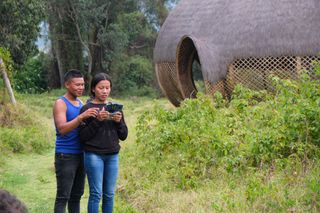
Participants of Colectivo Takaka at Organizmo (Image credit: Courtesy of Organizmo)
The most recent architectural venture onsite was the Maloca or House of Thought, built in the shape of a toroid, a geometry considered sacred, with four entrances signifying the four elements. A group of students led by architect Jaime Peña built this structure with non-glued laminated beams using bamboo from the southwestern Valle del Cauca, and a local roofing technique used by the Muisca people. ‘Architecture has to be like the loom, to visualise all the abundant languages in the territory,’ Gutiérrez says. ‘You create the scenario so all these old languages can be expressed and sheltered.’
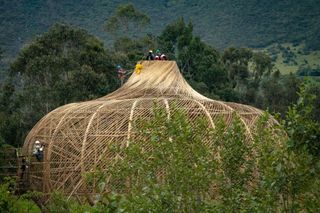
Building House of Thought, a toroidal structure at Fundacion Organizmo (Image credit: Felipe Cotero)
But the real purpose of Organizmo is fulfilled off site. For the past year, the foundation has been working on community projects in Vichada, on the border of Venezuela, and Vaupés, in the Amazonian region, to develop programmes of self-education and territorial harmonisation. ‘We support collective processes around local initiatives, strengthening their cultural expressions,’ Gutiérrez explains. This is in large part thanks to a two-year grant from re:arc Institute, a nonprofit based in Copenhagen that ties climate activism with architecture philanthropy under the framework of planetary wellbeing.
기사원문링크>
https://www.wallpaper.com/design-interiors/organizmo-sustainable-design